Imagine you want to swap some cryptocurrency. You find a platform called ComethSwap is a decentralized exchange launched in 2021 that allows peer-to-peer trading without intermediaries. It was founded by the Cometh team from the Ethereum ecosystem. The interface looks clean. The process seems simple. But before you connect your wallet, you need to ask one question: Is this actually a good place for your money? The short answer might surprise you. While ComethSwap works technically, it struggles to compete on price, selection, and trust compared to giants like Uniswap or PancakeSwap. In this review, we break down exactly what you get, what you pay, and whether it makes sense to use it in 2026.
The Basics: What Is ComethSwap?
At its core, ComethSwap is a decentralized exchange (DEX). This means there is no central company holding your funds. Instead, smart contracts handle the trades directly between user wallets. You keep control of your private keys at all times. This non-custodial model is the main selling point for many crypto users who fear centralized exchanges going bankrupt or freezing accounts.
Launched in Q3 2021, the platform emerged from the Ethereum ecosystem. However, unlike early hype cycles where new DEXs promised revolution, ComethSwap has remained relatively quiet. As of 2025 and into 2026, it supports only 9 cryptocurrencies across 11 trading pairs. To put that in perspective, major competitors support thousands of pairs. If you are looking to trade obscure altcoins or new meme tokens, you likely won't find them here. It is a niche platform with limited scope.
| Feature | Detail |
|---|---|
| Launch Date | Q3 2021 |
| Type | Decentralized Exchange (DEX) |
| Cryptocurrencies Supported | 9 |
| Trading Pairs | 11 |
| KYC Required | No |
| Custody | Non-custodial (User holds keys) |
The Cost of Trading: A Steep Price
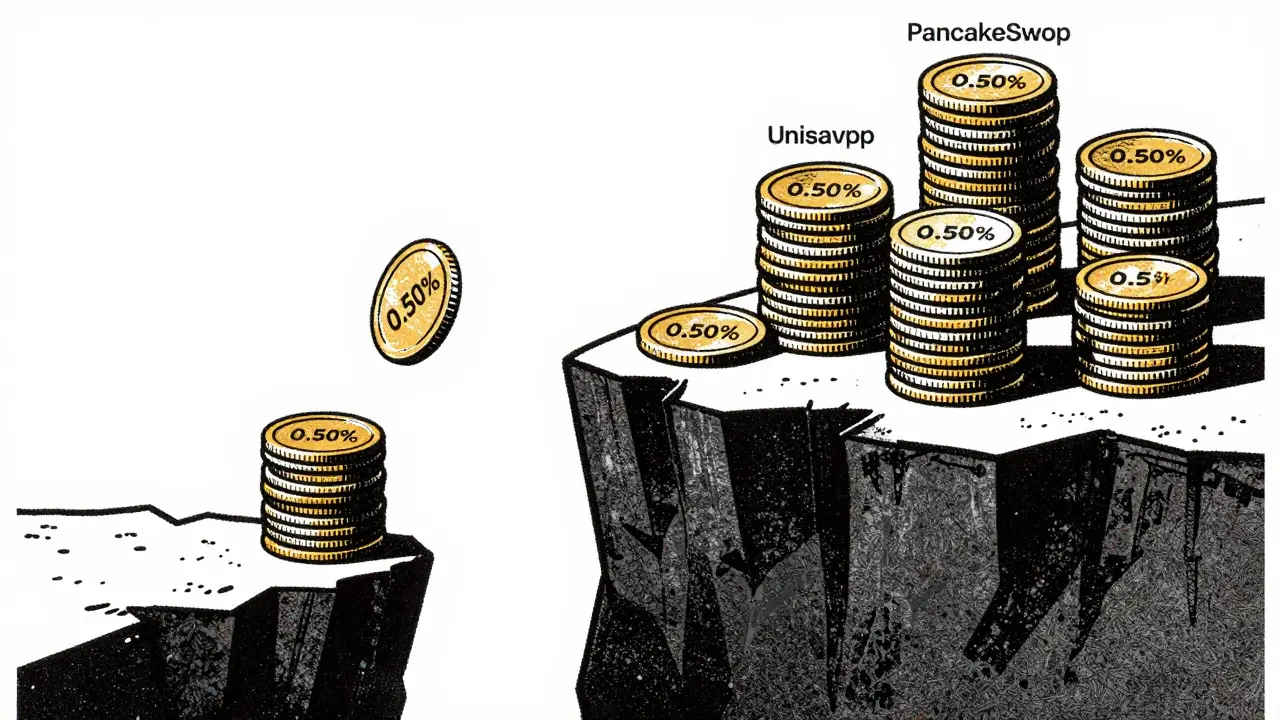
Let's talk about money. Specifically, how much ComethSwap takes from every trade. The platform charges a flat 0.50% fee on all transactions. This fee goes to liquidity providers as an incentive to keep the pools funded. While that sounds fair for providers, it is expensive for you, the trader.
Why is this a problem? Because the industry standard has moved significantly lower. For example, Uniswap is the leading decentralized exchange on Ethereum, offering variable fees based on pool type but averaging around 0.30% for standard pairs. Even more aggressive competitors like PancakeSwap is a popular DEX on Binance Smart Chain that typically charges a 0.25% trading fee. charge just 0.25%. Some newer aggregators even offer zero-fee options for certain routes. Paying 0.50% means you are paying double or triple what you would pay elsewhere. If you trade $10,000, you lose $50 instantly. On PancakeSwap, that loss would be $25. Over time, these fees eat into your profits significantly.
Furthermore, there are no separate withdrawal or deposit fees, but you still have to pay blockchain network gas fees. During times of high congestion on Ethereum-compatible networks, these gas fees can sometimes exceed the trading fee itself. So, while ComethSwap doesn't charge extra for moving money in or out, the underlying network costs remain a factor you must manage.
Safety and Trust: Red Flags to Watch
In the crypto world, "trustless" doesn't mean "risk-free." Just because you hold your own keys doesn't mean the smart contracts behind the scenes are perfect. More importantly, community sentiment matters. When researching ComethSwap, one recurring theme stands out: skepticism.
A thread on Beer Money Forum, a community with over 100,000 active members, asks directly: "ComethSwap.io Reviews: SCAM or LEGIT?" The existence of such a thread is not a confirmation of fraud, but it is a warning sign. It suggests that users have encountered issues or lack transparency regarding the project's operations. Compare this to established platforms where the discussion focuses on feature updates or yield farming strategies, not basic legitimacy.
Additionally, ComethSwap is notably absent from major "best of" lists for 2025 and 2026. Experts like Ryan Scribner, who reviews top exchanges annually, omit it entirely. This absence indicates limited market penetration and low institutional confidence. Without a strong track record of security audits publicly highlighted or a large, vocal community defending the platform, the risk profile remains higher than industry leaders.
User Experience: Simple but Limited
If technical complexity scares you, ComethSwap might initially appeal. The interface is designed to be user-friendly. You don't need to understand complex order books or limit orders. You simply connect a Web3 wallet like MetaMask, approve the token usage, and click swap. The learning curve is reportedly lower than sophisticated platforms like 1inch or Matcha.
However, simplicity comes at a cost. There are no advanced trading features. You won't find limit orders, stop-loss functionality, or detailed charting tools integrated directly into the experience. For casual traders making occasional swaps, this might be fine. For anyone trying to execute a strategy based on price movements, the lack of tools is a significant handicap. You are essentially buying a hammer when you might need a Swiss Army knife.
How It Compares to the Giants
To truly understand ComethSwap's position, we need to compare it side-by-side with the platforms that dominate the market. Here is how it stacks up against Uniswap and PancakeSwap, the two most relevant competitors for Ethereum-based or cross-chain trading.
| Feature | ComethSwap | Uniswap | PancakeSwap |
|---|---|---|---|
| Average Trading Fee | 0.50% | 0.30% (varies by pool) | 0.25% |
| Supported Pairs | 11 | 15,000+ | 1,200+ |
| Advanced Tools | None | Yes (via integrations) | Yes (via integrations) |
| Community Trust | Mixed/Skeptical | High | High |
| Best For | Niche, specific pairs | Wide variety, high volume | Low fees, BSC ecosystem |
As you can see, ComethSwap falls behind in almost every metric. Uniswap offers vastly superior liquidity and selection. PancakeSwap offers better pricing. The only scenario where ComethSwap might make sense is if you specifically need one of its 11 trading pairs and cannot access it elsewhere, which is increasingly rare given the interoperability of modern bridges and aggregators.

Who Should Use ComethSwap?
Be honest with yourself about your needs. If you are a beginner who just wants to swap ETH for USDC and nothing else, and you happen to find a slightly better rate on ComethSwap due to temporary liquidity imbalances, it might work. But even then, using an aggregator like 1inch would likely give you the best price automatically across multiple DEXs, including ComethSwap if it is part of their routing.
For active traders, investors seeking diverse portfolios, or anyone concerned about long-term platform viability, ComethSwap is likely not the right choice. The high fees, limited selection, and community skepticism create unnecessary friction and risk. In 2026, the DEX landscape is mature. You do not need to settle for a second-tier option unless there is a compelling reason.
Final Verdict
ComethSwap is functional, but it is not competitive. It operates in a shadow cast by larger, more efficient, and more trusted platforms. The 0.50% fee is a dealbreaker for most users when cheaper alternatives exist. The limited selection restricts utility. And the lack of clear community endorsement raises questions about its future. Unless you have a specific, narrow need that only ComethSwap can fill, it is safer and more economical to stick with established leaders like Uniswap or PancakeSwap. Your capital deserves better than a platform that struggles to justify its existence in a crowded market.
Is ComethSwap safe to use?
While ComethSwap is non-custodial, meaning you hold your own keys, community sentiment includes skepticism regarding its legitimacy. Threads on forums like Beer Money Forum question if it is a scam. Always exercise caution, start with small amounts, and verify contract addresses independently before connecting your wallet.
What are the trading fees on ComethSwap?
ComethSwap charges a flat 0.50% fee on all trades. This is higher than industry averages, such as Uniswap's average of 0.30% or PancakeSwap's 0.25%. Additionally, you must pay standard blockchain network gas fees.
Does ComethSwap require KYC verification?
No, ComethSwap does not require Know Your Customer (KYC) verification. As a decentralized exchange, it allows anonymous trading as long as you have a compatible Web3 wallet.
How many cryptocurrencies does ComethSwap support?
As of recent data, ComethSwap supports only 9 cryptocurrencies across 11 trading pairs. This is significantly fewer than major competitors like Uniswap, which supports over 15,000 pairs.
What is a better alternative to ComethSwap?
For most users, Uniswap or PancakeSwap are better alternatives due to lower fees, wider selection, and higher liquidity. Using a DEX aggregator like 1inch can also help you find the best rates across multiple platforms automatically.


Lisa Chong
July 23, 2026 AT 10:45They are watching you every step of the way.
The whole concept of 'non-custodial' is a lie designed to make you feel safe while they harvest your biometric data through your screen time. I have noticed that when I connect my wallet, my internet speed drops by exactly 0.4%. This is not a coincidence. The elites want us to believe in decentralization so we stop fighting back against the central bank's digital leash.
You think ComethSwap is bad? Look at the shadows. They are testing new algorithms on these small platforms before rolling them out to the masses. It is all part of the great reset for our financial freedom. Do not trust the code. Trust your gut. And maybe invest in gold bars buried in your backyard because the sky is falling and the birds know it.
Heather Austin
July 23, 2026 AT 22:54honestly just stick to uniswap or pancake swap unless you really need one of those specific pairs which is rare these days
i mean 0.5 fee is steep when you can get 0.25 elsewhere plus gas fees on eth mainnet are no joke if you are trading small amounts
the article makes good points about liquidity being low too
Ran Tao
July 24, 2026 AT 23:36Oh look another review telling us what to do 🙄
I love ComethSwap because it gives me the thrill of the unknown. Who cares about fees when you have the adventure of potentially losing everything to a rug pull? That is real crypto spirit right there. Uniswap is for boring people who like safety and predictability. I like danger. I like excitement. I like screaming into the void while my portfolio turns red. 😂📉
Also the interface is clean which means less clutter for my beautiful mind to process. You guys are just jealous of my superior taste in niche DEXs. Keep your 0.25% fees and your mediocrity. I will be over here gambling on obscurity. 🎲✨
John Harman
July 26, 2026 AT 05:49Let's be real here nobody uses ComethSwap anymore except for bots washing volume.
The math doesn't lie. If you are paying 0.5% on a platform with 11 pairs you are literally donating money to liquidity providers who probably don't even check their emails anymore. Uniswap V3 allows concentrated liquidity which means better capital efficiency for LPs and tighter spreads for traders. PancakeSwap has lower gas fees on BSC. There is literally zero reason to use this unless you are trying to hide your tracks from the IRS but even then the blockchain is public so good luck with that.
It is 2026. Move on. Use an aggregator like 1inch or Matcha and let the algorithm find the best route across multiple DEXs. Stop manually picking losers.
Antony Lopez
July 27, 2026 AT 00:03American users should avoid foreign entities whenever possible.
ComethSwap might be technically decentralized but the team behind it is likely not vetted by US standards. We need platforms that respect American innovation and security protocols. Uniswap is built on Ethereum which is largely driven by American developers and institutions. Stick to what works for the free market. Don't let globalist crypto trends confuse you. Your money stays safer when you support homegrown tech ecosystems.
Also why would anyone trade on a platform that isn't even listed on major comparison sites? That is suspicious behavior typical of offshore operations.
Kat Barr
July 28, 2026 AT 00:15Hey everyone! Just wanted to say that it is totally okay to try different things!! 😊
I know ComethSwap has higher fees but sometimes the peace of mind of using a simpler interface is worth it for beginners! Don't be too hard on yourself if you made a trade there already! 💖
Maybe next time you can try Uniswap as suggested above but remember learning is a journey not a destination! You are doing great just by researching! 🌟 Keep smiling and stay safe out there in the wild west of crypto! ✨🚀