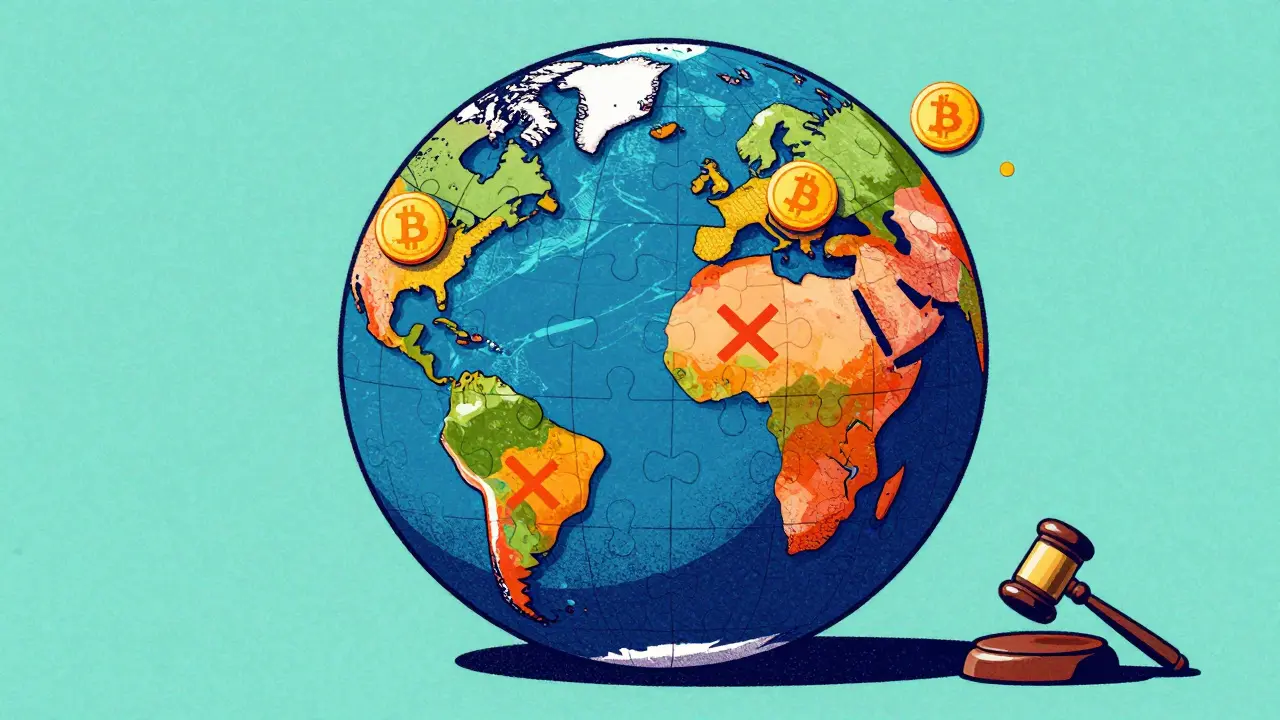
Imagine waking up to find that the digital assets in your wallet are suddenly illegal to trade, or conversely, that you can now pay for your morning coffee with Bitcoin as a government-backed currency. This isn't a sci-fi plot; it's the current reality of the global financial map. While cryptocurrency legal status is the regulatory framework determining whether digital assets can be owned, traded, or used as currency within a specific jurisdiction, there is no single global rulebook. Instead, we have a fragmented patchwork where one country views a token as a commodity, another as a security, and a third as a criminal offense.
The core problem for any investor or business owner is the sheer unpredictability of these laws. A move that's legal in Portugal could be a felony in China. However, the trend is shifting toward formalization. With the global market hitting $1.89 trillion recently, governments are moving away from blind bans and toward complex frameworks that try to balance innovation with financial stability.
Quick Takeaways: The Global Crypto Map
- The Legal Leaders: About 45 nations have fully legalized and regulated crypto.
- The Outliers: Only El Salvador and the Central African Republic treat Bitcoin as legal tender.
- The Hard Bans: Countries like China and Saudi Arabia maintain strict prohibitions.
- The New Standard: The EU's MiCA regulation is now the most comprehensive blueprint for other nations to follow.
- The Paradox: Some of the highest adoption rates are found in countries with the most restrictive or "gray" laws.
The Four Main Regulatory Approaches
To make sense of the chaos, it helps to group countries by how they handle digital assets. Most jurisdictions fall into one of four buckets based on the Atlantic Council's tracking data.
First, there are the Legal and Regulated nations. These countries don't just allow crypto; they've built a set of rules around it. The United States is a prime example, though its approach is a bit messy. You have the SEC (Securities and Exchange Commission) calling some tokens securities, the CFTC (Commodity Futures Trading Commission) calling Bitcoin a commodity, and the IRS treating it all as property for tax purposes. It's a lot to track, but the baseline is: yes, it's legal.
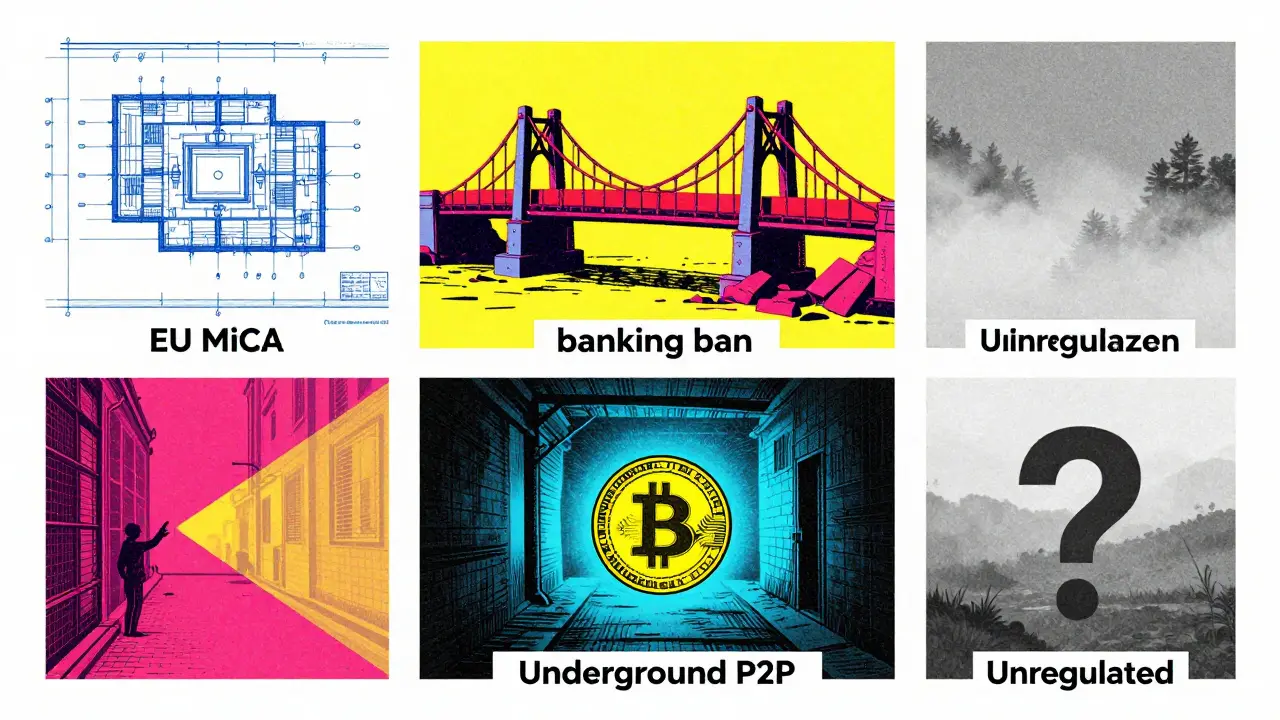
Then you have Partially Banned jurisdictions. Here, you might be allowed to own crypto, but you can't use it to buy a sandwich. Namibia uses a banking ban model, meaning banks can't touch crypto exchanges, effectively cutting off the bridge between digital assets and traditional cash.
The Generally Banned group is the smallest but loudest. China famously banned all trading and mining in 2021. These bans are often designed to protect the national currency or stop capital flight, though as experts like Dr. Sheila Warren have noted, they rarely stop people from using the tech-they just push it underground into peer-to-peer (P2P) networks.
Finally, there are the Undecided or Unregulated countries. In places like Angola, the government might advise against using Bitcoin, but there's no actual law forbidding it. This creates a "gray zone" that can be attractive for some but risky for businesses that need legal certainty to get funding.
| Region/Country | Legal Status | Primary Attribute | Key Regulator/Law |
|---|---|---|---|
| European Union | Legal & Regulated | Unified Framework | MiCA Regulation |
| United States | Legal & Regulated | Multi-Agency Oversight | SEC / CFTC / IRS |
| El Salvador | Legal Tender | State-Backed Adoption | Bitcoin Law (2021) |
| China | Banned | Total Prohibition | PBOC Guidelines |
| Portugal | Legal | Tax-Friendly (0% for individuals) | National Tax Authority |
Regional Deep Dives: From Tax Havens to Hard Lines
If you're looking for a place to set up a crypto business, the European Union is currently the gold standard thanks to MiCA (Markets in Crypto-Assets). This regulation creates a single set of rules for all 27 member states, meaning if you're licensed in one, you can essentially operate across the whole bloc. It's a massive shift toward clarity, focusing on stablecoin issuers and transparency.
In contrast, look at the tax strategies. Portugal has become a magnet for "crypto nomads" by offering 0% tax on income from bitcoin transactions for individuals. On the other end, Brazil takes a more active approach, taxing gains at 15% for transactions over BRL 35,000 a month. This shows that even among "legal" countries, the financial impact of owning crypto varies wildly.
Southeast Asia is a bit of a rollercoaster. While Vietnam and India have some of the highest adoption rates in the world, the legal side is often murky. Cambodia, for instance, blocked access to giants like Binance and Coinbase in late 2024 because they lacked local licenses, even while the government was building its own digital currency project, "Project Bakong." It's a classic case of a government wanting the tech, but only if they control the keys.
The High-Adoption Paradox
One of the most interesting things about crypto is that legality doesn't always drive usage. In fact, some of the most restrictive environments see the most growth. Take Venezuela. Because the bolivar has been crushed by hyperinflation, people have flocked to crypto for survival, regardless of whether the laws are clear. This creates a strong correlation between economic instability and crypto adoption.
We see similar patterns in Nigeria and Turkey, where ownership rates exceed 20%. When your local currency is losing value daily, a "regulatory gray area" is a small price to pay for a stable store of value. This is why purely banning cryptocurrency is often an exercise in futility; the demand comes from a need for financial autonomy that laws can't erase.
Doing Business: The Cost of Compliance
If you're thinking of launching an exchange, be prepared for a long and expensive road in regulated markets. In the US, you can't just start a website. You need to register as a Money Services Business (MSB) with FinCEN, which alone can cost up to $10,000 in fees. Then, you have to get money transmitter licenses state-by-state, which can take months and cost thousands per state.
The EU's MiCA framework is more streamlined but still costly. Medium-sized exchanges are looking at about €250,000 for the initial setup and another €75,000 every year just to keep the lights on legally. Compare that to an unregulated market like Angola, where you can start in a few months because there are no rules-but you also face a 38% higher failure rate because you might wake up one day to find your entire business is now illegal.
The Rise of CBDCs and the Future Landscape
Governments are realizing they can't beat the blockchain, so they're trying to build their own. This is where CBDCs (Central Bank Digital Currencies) come in. About 92% of the countries studied by the Atlantic Council are now working on these. The European Central Bank, for example, is timing its digital euro pilot to coincide with MiCA's rollout.
The goal here is a hybrid future. We're moving toward a world where private cryptocurrencies (like Bitcoin or Ethereum) and state-issued digital currencies exist side-by-side. The Financial Action Task Force (FATF) is already pushing for a "Travel Rule," requiring exchanges to share user info for transactions over $1,000. This is the "civilizing" phase of crypto-bringing the wild west under the umbrella of global AML (Anti-Money Laundering) standards.
Is cryptocurrency legal in the United States?
Yes, it is legal to own and trade cryptocurrency in the U.S. However, it is heavily regulated. The SEC, CFTC, and IRS each have different rules regarding how assets are classified and taxed. While the act of owning crypto is legal, running an exchange requires extensive licensing (like MSB registration) and compliance with state and federal laws.
Which countries have the most crypto-friendly laws?
Portugal is highly regarded for its low taxes (0% for individuals in some cases). Malta, known as "The Blockchain Island," has some of the most advanced specific legal frameworks for digital assets. Switzerland and Singapore are also top choices for professional traders due to high regulatory clarity and supportive business environments.
What is MiCA and why does it matter?
MiCA (Markets in Crypto-Assets) is the European Union's comprehensive regulatory framework. It matters because it creates a single set of rules for all 27 EU member states, reducing the need for companies to apply for different licenses in every country and providing a blueprint for how other global regions might regulate stablecoins and service providers.
Can I use Bitcoin as legal tender anywhere?
As of 2026, El Salvador and the Central African Republic are the primary nations that have adopted Bitcoin as legal tender. This means businesses are legally required to accept it as payment if they have the technology to do so, and it exists alongside their national currencies.
What happens if I trade crypto in a country where it's banned?
In countries like China, bans are strictly enforced, and attempting to use centralized exchanges often results in account freezes or legal penalties. Many users in banned jurisdictions turn to P2P (peer-to-peer) trading platforms to bypass these restrictions, but this carries significant risks, including scams and the potential for criminal prosecution under anti-money laundering laws.
Next Steps: Navigating the Legal Maze
If you're a casual investor, your biggest priority is tax compliance. Before the end of the year, map out every transaction you've made and check if your local tax authority treats crypto as property (like the US) or has specific exemptions (like Portugal). Use a dedicated crypto tax software to avoid surprises during audit season.
For those looking to launch a project or exchange, the strategy is all about "Regulatory Arbitrage." This means choosing a jurisdiction that offers the best balance of legal clarity and low entry costs. If you have the capital, the EU (via MiCA) offers the most stability. If you're bootstrapping, look toward emerging hubs like the UAE or Singapore, but ensure you have a legal consultant to handle the specific licensing requirements for that region.


Noel Mandotah
April 25, 2026 AT 13:33Oh look, another guide explaining that the US government can't make up its mind about what a token is. Truly groundbreaking stuff. 🙄
Livvy Cooper
April 26, 2026 AT 20:16This whole thing is just a way for rich people to hide money. It's wrong and it's bad for the world. Why do we even let this happen?
Rain Richardsson
April 27, 2026 AT 03:09That bit about Venezuela is really eye-opening. It's wild how necessity drives the tech way more than the laws do.
Iestyn Lloyd
April 28, 2026 AT 23:46The MiCA framework is actually quite a sophisticated piece of legislation. It provides the kind of institutional certainty that the UK has been struggling to fully implement, and it's likely to become the global blueprint for several years. Most people underestimate the importance of a unified passporting system within the EU, as it removes the friction of dealing with twenty-seven different regulators simultaneously. This shift toward formalization is a natural progression for any asset class that wants to move from a niche hobby to a legitimate part of a retirement portfolio. In the UK, we've seen a similar lean toward regulation, though the pace differs. It's a balance between fostering a "fintech hub" image and ensuring consumers aren't wiped out by the next big collapse. If you're looking at this from a business perspective, the legal clarity in the EU is currently far more attractive than the "wait and see" approach seen in other G7 nations. It's simply about risk mitigation in a highly volatile environment. I'd suggest anyone moving into this space look deeply at the reporting requirements, as the "Travel Rule" is going to make anonymity a thing of the past very quickly. Compliance is the new competitive advantage in the digital asset world. It's not as exciting as the "wild west" days, but it's how you actually build a sustainable company. 결국, stability wins over chaos every single time.
Kara Spadone
April 29, 2026 AT 22:47The energy of this post is so chaotic 🌀. We are just chasing digital ghosts while the Earth burns 🌍. Truly a mirror of our collective greed ✨.
April D Thompson
April 30, 2026 AT 11:39I love how we're seeing a global awakening here! It's like we're witnessing the birth of a new financial consciousness. We have to remember that these laws are just the old world trying to put a leash on a spirit that's already flown away! It's such a beautiful, messy transition toward a more inclusive future where the gatekeepers finally lose their keys. Let's embrace the chaos as a catalyst for growth! 🌟