Creator Earnings Comparison Calculator
Compare Your Earnings
See how much more you could earn with digital ownership versus traditional platforms. Input your current stats to see potential differences in revenue.
| Category | Traditional Platforms | Blockchain Ownership |
|---|---|---|
| Primary Revenue | $0.00 | $0.00 |
| Secondary Royalties | $0.00 | $0.00 |
| Platform Fees | $0.00 | $0.00 |
| Net Earnings | $0.00 | $0.00 |
| Long-term Value | Not applicable | $0.00 |
| Revenue Difference | $0.00 | |
How Your Numbers Compare
Based on your inputs, blockchain ownership can potentially earn you 0% more income than traditional platforms over 6 months.
Traditional platforms take 45% of your revenue, while blockchain platforms typically charge only 3% in fees.
For years, creators have been told to build audiences on platforms like YouTube, Instagram, and Spotify. But here’s the truth: those platforms own your audience, your data, and your revenue. You don’t own your work-you’re renting space. And when the algorithm changes, your income drops. That’s changing. With blockchain, creators are finally gaining digital ownership-real, verifiable control over their content, income, and community.
What Digital Ownership Actually Means
Digital ownership isn’t just about selling an NFT. It’s about owning the rights to your work, the data around it, and how it’s used. Before blockchain, if you uploaded a song to Spotify, you got 45-55% of the revenue. The rest went to the platform, distributors, and middlemen. If you posted art on Instagram, the platform could sell ads around your work, track your followers, and even mute your posts without warning. You had no say. With digital ownership, you mint your art, music, or writing as a unique digital asset on a blockchain-usually Ethereum, Solana, or Polygon. This asset is tied to your wallet. No one else can claim it. You control who buys it, how much it costs, and what happens next. Smart contracts automatically pay you royalties every time your work is resold. That’s not a promise. It’s code. And it runs 24/7, no middleman needed.How It Works: Wallets, Smart Contracts, and Provenance
Getting started is simpler than you think. First, you need a crypto wallet-MetaMask or Phantom are the most common. Setting one up takes five minutes. You don’t need to understand crypto to use it. Think of it like an email address for your digital stuff. Next, you mint your creation. This means turning your file-whether it’s a JPEG, MP3, or PDF-into a unique token on the blockchain. Platforms like Mirror.xyz, Foundation, or OpenSea handle the technical side. You pay a small fee (called a gas fee), which on Polygon averages $0.50 to $2.00 as of late 2025. That’s less than a coffee. The magic happens with smart contracts. These are self-executing programs stored on the blockchain. When you mint, you set rules: “I get 10% every time this NFT is sold.” That’s it. No negotiations. No invoices. The next buyer pays you automatically. If your piece sells for $5,000 in six months, you get $500-just for creating it once. Provenance is permanent. Every owner, every sale, every transfer is recorded on the blockchain. No one can fake it. That’s why collectors trust NFTs from verified creators. It’s not just art. It’s history.Real Earnings: Numbers That Matter
Let’s talk money. Traditional platforms take a big cut. YouTube keeps 45%. Spotify takes 30%. Even Patreon takes 5-12%. On decentralized platforms like Mirror or Rally, platform fees drop to 2-5%. That’s a massive difference. Harvard’s 2023 study found artists using NFTs earned 3.2 times more per transaction than on traditional marketplaces. Why? Because of secondary royalties. On Spotify, you only get paid when someone streams. On blockchain, you get paid every time your art changes hands. One musician, RAC, made $1.2 million from NFT sales in 2023-27% of his total income-while keeping 95% ownership of his rights. Another creator, known as DigitalArtistMike, earned $12,000 in secondary royalties over 18 months from a single NFT drop of 200 pieces. Each sold for 0.1 ETH. That’s passive income from a one-time effort. But it’s not just about sales. Token-gated communities-where only NFT holders can join private Discord servers or access exclusive content-see 47% higher engagement than regular social media followers. That’s not just numbers. That’s loyalty. That’s a real fanbase you own.
Why Creators Are Switching
The shift isn’t just about money. It’s about control. In 2024, 78% of professional artists using NFTs said they had more creative freedom. 65% said their income became more sustainable. No more waiting for platform approval. No more demonetization. No more shadow bans. A writer on Mirror.xyz can publish a serialized novel as NFT chapters. Readers buy them. The writer keeps 95%. If someone translates it, the smart contract can be set to pay the writer a cut. If a filmmaker wants to adapt it, they have to negotiate directly. The creator isn’t just a vendor. They’re the owner. This is why 58% of creators using digital ownership report higher job satisfaction, according to Ideaology.io’s 2024 survey. They’re not chasing views. They’re building legacies.The Hard Parts: What No One Tells You
Let’s be real. This isn’t magic. There are hurdles. First, gas fees can spike. In January 2024, Ethereum fees hit $50 per transaction during a rush. That’s why most creators now use Layer 2 networks like Polygon or Arbitrum, where fees stay under $2. It’s a technical detail, but it matters. Second, wallet recovery is a nightmare for 28% of new creators, according to Ledger’s 2025 report. Lose your seed phrase? Lose your work. No customer service can fix that. You have to backup your keys like you’d backup your house keys. Third, not all platforms are equal. OpenSea has great guides. Many decentralized platforms? Not so much. A 2024 survey found creators gave decentralized marketplaces an average satisfaction score of 3.1 out of 5 for documentation. You’ll need to learn on your own. And then there’s the learning curve. It takes 15-20 hours to get comfortable with wallets and marketplaces. Another 40-60 hours to design tokenomics-how you reward holders, structure drops, build community. That’s not small. But it’s an investment. And it’s one-time.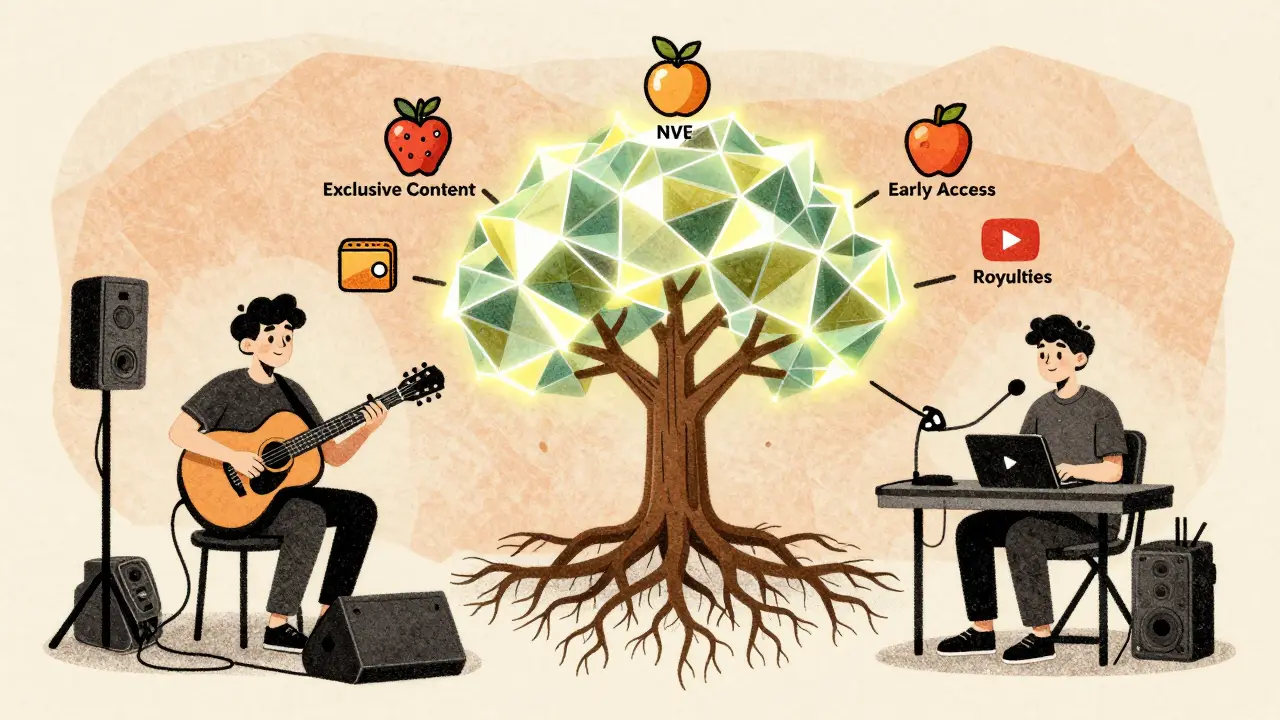
Who’s Winning-and Who’s Not
The data shows clear patterns. Musicians make up 32% of adopters. Visual artists are at 29%. Writers and podcasters are at 18%. Most users are between 25 and 44. That’s not random. These are people who understand value, community, and direct relationships. Success stories aren’t about viral drops. They’re about consistency. RAC didn’t make $1.2 million because he minted one NFT. He built a community, released weekly drops, and kept fans engaged for years. On the flip side, the CryptoArtistsUnited collective dissolved in early 2024. Why? They had 5,000 NFT holders-but no plan to turn them into a community. Ownership without engagement is just a spreadsheet. The lesson? Digital ownership doesn’t replace community. It amplifies it. You can’t just sell NFTs. You have to build something people want to be part of.The Future: Hybrid Models Are Here
You don’t have to choose between YouTube and blockchain. The future is hybrid. A YouTuber might post a video on YouTube, then release a behind-the-scenes NFT collection for superfans. A podcaster might give free episodes to everyone, but sell exclusive bonus chapters as NFTs. Shopify’s “Ownable” API, launched in August 2025, lets 2.1 million merchants add digital ownership to their stores. That’s not a niche tool anymore. It’s infrastructure. Ethereum’s Dencun upgrade in 2024 slashed NFT costs by 90%. Cross-chain interoperability is coming in 2026. The World Wide Web Consortium is working on standardized royalty enforcement. Regulation is slowly catching up-EU’s MiCA framework is clear. The U.S. is messy, but progress is happening. By 2030, Harvard researchers predict digital ownership will be standard for 40-60% of premium creator content. That’s not speculation. It’s a trajectory.What You Should Do Now
Start small. Pick one piece of work-a song, a drawing, a short story-and mint it on Polygon. Use OpenSea or Foundation. Keep the mint price low ($5-$10). Don’t aim for a viral hit. Aim for 10 real fans who believe in you. Set up a Discord server. Invite your buyers. Say thank you. Share updates. Ask what they want next. That’s the secret. Ownership isn’t about the token. It’s about the relationship. You don’t need to become a crypto expert. You just need to own your work. And that’s the biggest advantage you’ve ever had as a creator.Can I still use YouTube and Instagram if I use blockchain for digital ownership?
Yes. Digital ownership doesn’t replace traditional platforms-it complements them. You can post your content on YouTube to grow your audience, then offer exclusive NFTs, behind-the-scenes content, or early access to superfans through your own blockchain-based community. Many successful creators use both: free content to attract people, paid ownership to deepen relationships.
Do I need to buy cryptocurrency to start?
You don’t need to buy crypto upfront. Most platforms let you mint using a credit card or fiat payment. But to receive payments, you’ll eventually need a wallet (like MetaMask) to hold ETH, SOL, or MATIC. You can start by creating an account and linking a card. Later, you can transfer earnings to your wallet. No need to understand crypto before you begin.
What happens if someone copies my digital art?
Anyone can copy a JPEG file. But only one person owns the original NFT on the blockchain. That’s like printing a Picasso-anyone can make a poster, but the original is still yours. Ownership proves authenticity. Buyers pay for the verified original, not the copy. This is why collectors value NFTs: they’re not buying pixels. They’re buying proof.
Are NFTs bad for the environment?
Early blockchains like Ethereum used a lot of energy. But since the 2022 Merge, Ethereum uses 99.95% less energy. Today, most NFTs are created on networks like Polygon and Solana, which are as energy-efficient as sending an email. The entire blockchain sector uses just 0.02% of global electricity-less than streaming video. Environmental concerns are outdated for modern NFTs.
Can I sell the same artwork on traditional platforms and as an NFT?
Yes. Many creators do. You can sell a print on Etsy, stream the music on Spotify, and offer the original NFT to collectors. The NFT doesn’t restrict your rights-it enhances them. You’re not giving up anything. You’re adding a new revenue stream with full control.
How long does it take to start earning with digital ownership?
It depends. Some creators earn within days. Others take months. The key isn’t speed-it’s consistency. Building a community takes time. One creator spent 11 months posting daily on Discord before her first NFT drop sold out. But then she earned $8,000 in secondary royalties over the next year. Digital ownership rewards patience and connection, not hype.
Is digital ownership just a trend?
It’s not a trend. It’s infrastructure. Just like websites replaced flyers, and smartphones replaced cameras, blockchain is replacing platform-based control. Companies like Shopify, Adobe, and even major record labels are building tools for creator ownership. The technology is maturing. Adoption is growing. This is the next evolution of the creator economy-not the end of it.
Candace Murangi
December 16, 2025 AT 09:35Been using Polygon for my digital sketches since last year. Paid for my rent for three months straight just from secondary sales. No platform can take that away. It’s not hype-it’s just how it works now.
Also, the Discord group I built around my drops? Way more real than any Instagram comment section. People actually talk to me. Weird, right?
Abhishek Bansal
December 17, 2025 AT 13:34lol you think this is new? remember when everyone was gonna make money from YouTube ads? then demonetization happened. same story. blockchain is just the new shiny thing they’re selling to desperate artists.
also, you’re telling me i should pay $2 to mint a jpeg so some rich guy can flex it in his metaverse apartment? cool.
Ian Norton
December 18, 2025 AT 20:35Let’s cut through the crypto bro noise. The 3.2x earnings stat? Cherry-picked outliers. The median NFT creator earns $117/year after gas fees. That’s not a career. That’s a hobby with extra steps.
And don’t get me started on ‘ownership.’ You don’t own the IP unless you hold the copyright. A blockchain token doesn’t change that. Legal systems still operate on traditional copyright law. You’re confusing provenance with rights.
Andy Walton
December 20, 2025 AT 14:03bro… i just minted my cat meme as an nft and now i feel… spiritually aligned?? 🌌✨
like, i’m not just posting content anymore, i’m *co-creating reality* with my community. every time someone buys it, i feel the universe whispering ‘you’re worthy’…
also my seed phrase is written on a napkin under my couch. it’s fine. vibes are strong. 💫
ps: if you’re not using solana, you’re not living. the gas fees are basically free energy from the cosmos.
Lois Glavin
December 22, 2025 AT 13:32I started small-just one drawing, $5 mint on Polygon. Didn’t sell out right away. But I replied to every buyer, asked what they liked, made a little Discord. Now I’ve got 87 people who check in every week.
It’s not about getting rich. It’s about not feeling invisible anymore. That’s worth more than any algorithm.
Jessica Petry
December 23, 2025 AT 16:37It’s amusing how the ‘creator economy’ keeps rebranding itself as liberation while still centering capitalistic extraction. You’re not free if you’re forced to perform ownership to be seen.
And let’s be honest-this is just Web2 with more gas fees and worse UX. The ‘community’ is just a marketing funnel dressed in blockchain glitter.
Also, your ‘hybrid model’ is just capitalism with more steps. Congratulations, you’ve invented Patreon 2.0.
Eunice Chook
December 23, 2025 AT 20:45Stop. Just stop. You don’t own your art if you can’t even access it without a 12-word passphrase you wrote on a sticky note. That’s not ownership. That’s digital hostage-taking.
Also, ‘provenance’ doesn’t mean anything if nobody cares who owned it 3 years ago. Most NFTs are just JPEGs with a blockchain stamp. The value is in the hype, not the code.
Bridget Suhr
December 25, 2025 AT 16:34My mom bought my first NFT. She didn’t know what crypto was. She just said, ‘I like your drawings, honey.’ That’s all I needed. I cried. No platform ever made me feel that.
And yeah, I lost my wallet once. Took me 3 weeks to recover. Learned my lesson. Now I have three backups. And I still think it’s worth it.