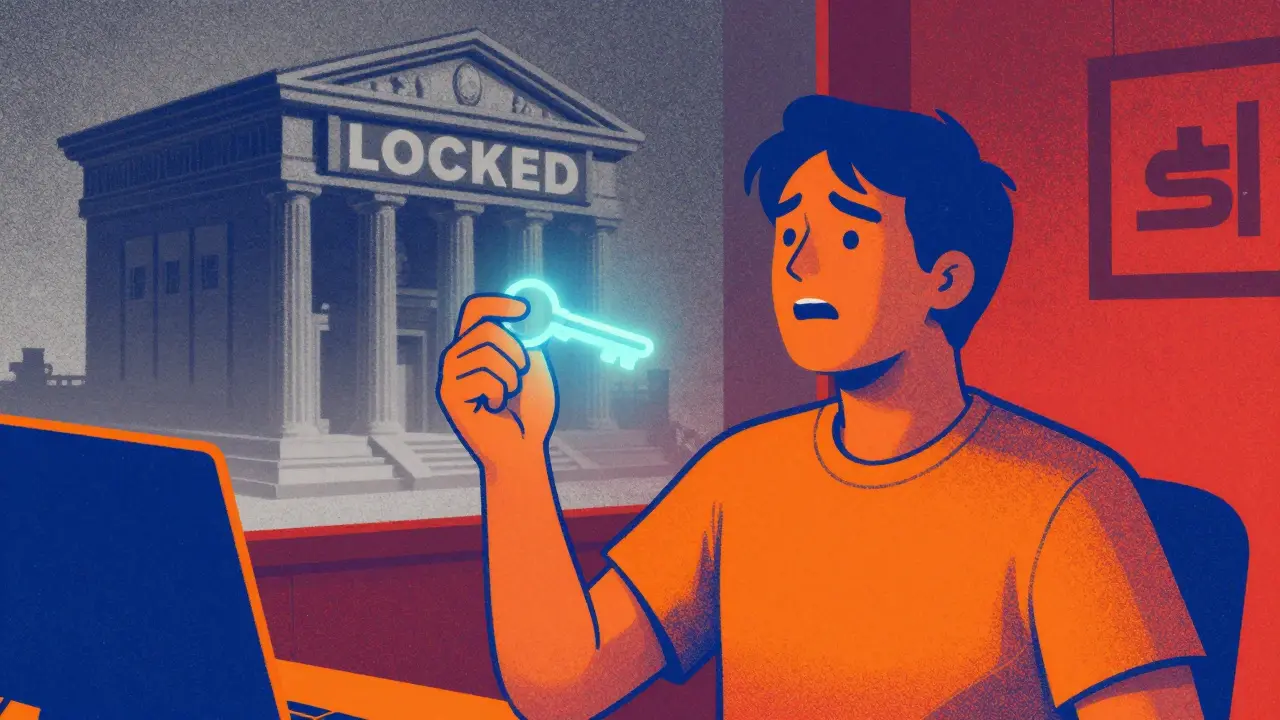
Imagine waking up to find your bank account frozen or your exchange account locked because of a sudden change in government policy. For millions of people in restricted countries, this isn't a nightmare-it's a reality. When a central authority decides you can't access your money, the only real solution is to own the "keys" to your assets. That is exactly where non-custodial crypto wallets is a type of digital tool that gives users complete and exclusive control over their private keys and cryptocurrency assets without needing a third-party intermediary. Also known as self-custody wallets, these tools ensure that no company or government can stop you from moving your funds.
Why Self-Custody is a Game Changer in Restricted Zones
In most parts of the world, using a crypto exchange is like using a bank; you trust the institution to hold your coins. But in countries with heavy restrictions, that trust is a liability. If an exchange is banned or shuts down, your assets are trapped. We saw this on a global scale during the November 2022 collapse of FTX, where users lost access to roughly $8 billion in assets. For someone in a restricted region, such a failure isn't just a financial loss-it's a total lockout from the global economy.
The magic of a non-custodial setup is that it removes the middleman. There is no KYC (Know Your Customer) process. You don't need to upload a passport, prove your residency, or ask for permission to open an account. You simply generate a set of keys and you are in. This allows users to interact directly with the blockchain, making them virtually invisible to the traditional regulatory checkpoints that usually block financial transactions.
Choosing Your Armor: Types of Non-Custodial Wallets
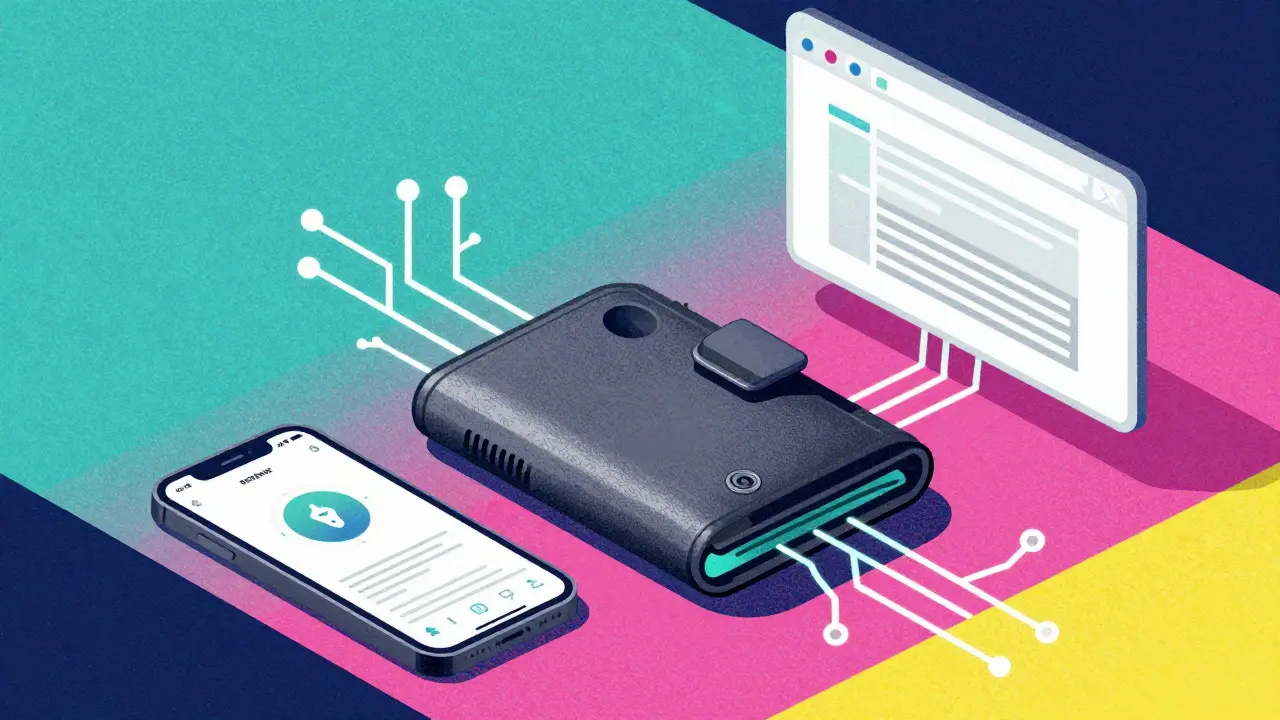
Not all wallets are created equal, especially when your physical or digital security is at risk. Depending on your level of technical skill and the severity of restrictions in your area, you'll likely choose between three main formats.
First, there are browser extensions. MetaMask is the most famous example. It lives in your web browser and acts as a bridge to decentralized applications. It's fast and convenient, but because it's connected to the internet, it's more vulnerable to phishing and malware.
Then you have mobile apps. Trust Wallet provides a similar experience to MetaMask but on your phone. These are great for quick transactions and checking balances on the go, though they share the same "hot wallet" risks as browser extensions.
Finally, for those who need maximum security, there are hardware wallets. Ledger devices, like the Nano S or Nano X, keep your private keys completely offline. Even if your computer is infected with a virus, the actual signing of the transaction happens inside the hardware device. In a restricted country, this "air-gapped" security is the gold standard because it prevents remote hacking of your funds.
| Feature | Browser Extensions (e.g., MetaMask) | Mobile Apps (e.g., Trust Wallet) | Hardware Wallets (e.g., Ledger) |
|---|---|---|---|
| Private Key Storage | Online (Hot) | Online (Hot) | Offline (Cold) |
| KYC Required | No | No | No |
| Setup Speed | Instant | Instant | Moderate (Requires Shipping) |
| Risk Level | Medium (Phishing/Malware) | Medium (Device Loss/Theft) | Low (Physical Access Only) |
The Golden Rule: Managing Your Recovery Phrase
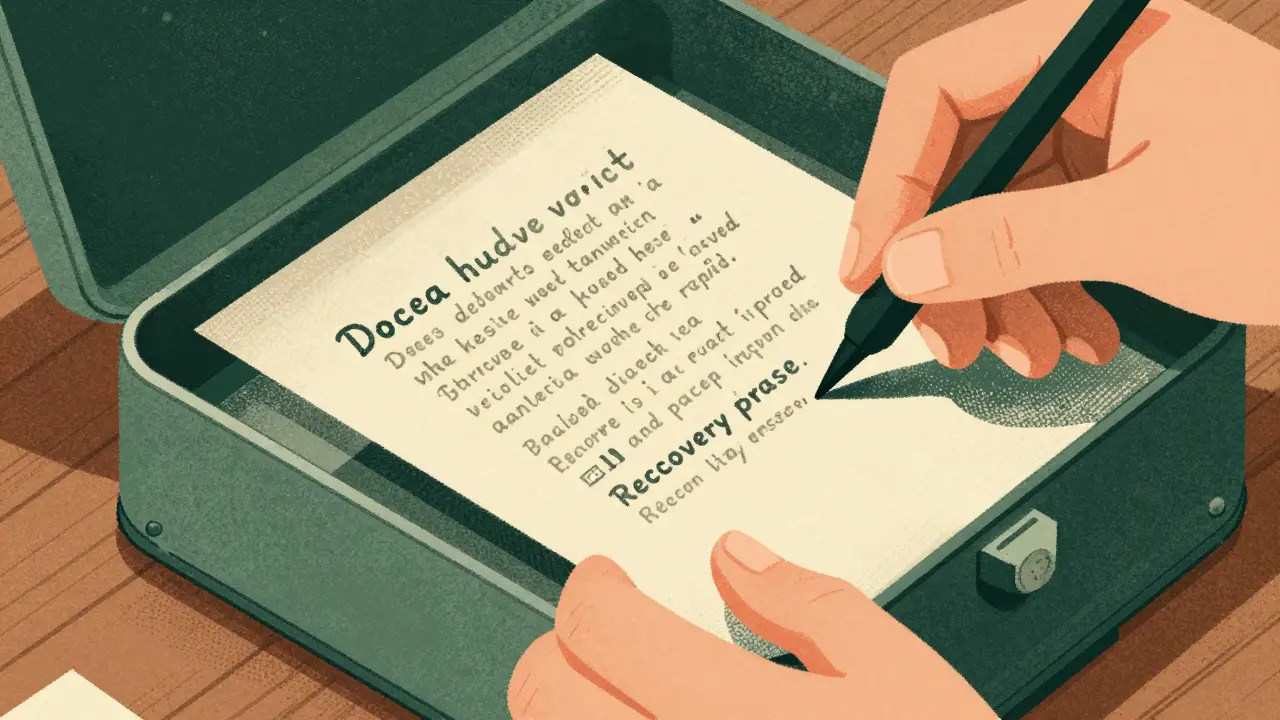
Here is the part where most beginners get scared: the recovery phrase. When you set up a non-custodial wallet, you get a 12 to 24-word seed phrase. This is the master key to your money. If you lose this phrase, your funds are gone forever. There is no "Forgot Password" button and no customer support team to call. In a restricted country, this burden is even heavier because you can't rely on traditional safety deposit boxes or digital clouds that might be monitored.
To do this right, avoid saving your phrase in a screenshot, an email, or a notes app. A simple hack could expose your entire fortune. Instead, write it down on paper or engrave it in metal and hide it in a secure physical location. Some advanced users use Shamir Backup, which splits the recovery phrase into multiple parts, so that losing one piece doesn't mean losing everything.
Navigating the Blockchain Without a Guide
Once your wallet is set up, you'll realize that non-custodial ownership requires a bit of a learning curve. You have to manually configure network parameters to interact with different blockchains like Ethereum, Solana, or the Binance Smart Chain. If you send coins to the wrong network, they might vanish into the digital void.
For people in restricted areas, the real power comes from Decentralized Exchanges (DEXs). Platforms like Uniswap or PancakeSwap allow you to swap one cryptocurrency for another without an account. You simply connect your wallet, make the trade, and disconnect. This bypasses the need for any centralized exchange that would otherwise require your ID or block your IP address.
Overcoming Common Barriers in Restricted Zones
Even with a non-custodial wallet, you might face obstacles. Many governments block the websites of wallet providers or blockchain explorers. This is where technical workarounds become necessary. Using a high-quality VPN (Virtual Private Network) is often the first step to even accessing the interface of your wallet or the DEX you want to use.
Another hurdle is the cost of moving money. Transaction fees, or "gas fees," vary wildly. On a congested network, a simple transfer might cost $50, while on others, it's less than a cent. Knowing which network to use can be the difference between a successful trade and losing half your funds to fees. It's a steep learning curve, often taking 10 to 40 hours of study to become truly proficient, but it's the price of financial freedom.
Risk Management: The Double-Edged Sword
We have to be honest: self-custody is a trade-off. You gain total sovereignty, but you lose the safety net. While you are protected from a company like FTX stealing your funds, you are now the only person responsible for your security. If you click a malicious link and sign a bad smart contract, a hacker can drain your wallet in seconds.
To stay safe, always verify contract addresses and never share your seed phrase with anyone-no matter how official they sound. In restricted countries, be mindful of your physical security. If a government official demands access to your device, having a hardware wallet with a hidden PIN or a passphrase can provide a layer of plausible deniability.
Can the government freeze funds in a non-custodial wallet?
No. Because you hold the private keys, there is no central entity for the government to send a court order to. However, if the tokens themselves are on a centralized bridge or a specific smart contract with "blacklist" functions, the developers of that specific token could potentially freeze them, though this is rare for major assets like Bitcoin or Ethereum.
What happens if I lose my recovery phrase?
If you lose your recovery phrase and lose access to the device where the wallet is installed, your funds are permanently irretrievable. There is no one to contact for a password reset because the wallet provider does not store your keys.
Are hardware wallets safer than mobile wallets?
Yes, significantly. Hardware wallets store private keys in an offline environment (cold storage), meaning they cannot be stolen by a remote hacker. Mobile wallets (hot wallets) are always connected to the internet, making them vulnerable to malware and phishing attacks.
Do I need a VPN to use a non-custodial wallet?
While the wallet software itself might work, you often need a VPN to access the websites of the wallet's interface or the decentralized exchanges (DEXs) you intend to use, as these are frequently blocked by national firewalls in restricted countries.
What is the cost of using a non-custodial wallet?
The wallet software itself is usually free. The only costs are the blockchain transaction fees (gas fees) paid to the network miners or validators. These fees range from a few cents to dozens of dollars depending on the network's traffic.
Next Steps for Your Financial Journey
If you are just starting, don't throw your life savings into a wallet on day one. Start by installing a browser extension like MetaMask and practicing with a tiny amount of funds. Once you understand how to send and receive, look into purchasing a hardware wallet for your long-term holdings.
For those in high-risk areas, research "multi-signature" wallets. These require more than one person to sign off on a transaction, which can prevent a single point of failure (or a single point of coercion). Your goal is to move from being a "user" of a service to being the "sovereign" of your own wealth.
Tara Aman
April 20, 2026 AT 00:43This is such a powerful reminder of why we need these tools! It is so inspiring to see how technology can actually give people their freedom back when the systems around them fail. Let's all keep learning and supporting each other through this process!
Eric Raines
April 21, 2026 AT 09:29Everyone acts like this is some secret revelation but literally any basic crypto user knows about seed phrases. It's not that deep. I've been doing this since the early days and honestly, the most "restricted" thing here is the reading level of some of these people trying to get into DeFi without knowing what a gas fee even is. Just google it, people.
Alex Hunter
April 23, 2026 AT 04:39Good breakdown. For those just starting, I'd suggest looking into different seed phrase storage methods beyond just paper, as fire or water damage can be a real risk. It's all about balancing convenience with safety.
Yvette P
April 24, 2026 AT 21:28Oh, wonderful, another guide telling people to trust their own ability to manage a 24-word mnemonic without losing it in a house fire or a divorce, because clearly, humans are legendary at keeping secrets safe. Let's just ignore the fact that the UX for most non-custodial interfaces is an absolute nightmare of hexadecimal strings and confusing RPC endpoints that would make a seasoned developer weep. It's just so quaint to think that a VPN and a Ledger are the ultimate armor against a state-level actor with a sophisticated surveillance apparatus and the power to simply arrest you for having the device in the first place. Truly, we are living in a techno-utopia where your entire net worth depends on a piece of plastic and your memory of where you hid a piece of foil.
Jason M
April 25, 2026 AT 16:52Wait, wait, wait! I cannot even begin to express the absolute terror I felt reading the part about losing a recovery phrase! It is a total heart-stopping nightmare! Imagine the agony of knowing your wealth is sitting right there on the blockchain, visible to the whole world, but you are locked out forever! It's a tragedy of digital proportions!
Jagdish Sutar
April 27, 2026 AT 12:05It is very important to remember that while these tools provide freedom, we should always help our elders and less tech-savvy friends in our communities set this up safely so they aren't left behind in the transition to digital finance.
Matthew Morse
April 29, 2026 AT 07:27too long didnt read just get a ledger
Candace Sherrard
April 30, 2026 AT 22:32There is something profoundly poetic about the shift from trusting a centralized institution to trusting a mathematical proof, yet it forces us to confront the terrifying reality of absolute personal responsibility. We spend our whole lives delegating our agency to banks and governments, and suddenly we are asked to be the sole guardians of our own survival, which is a heavy psychological burden for many to carry. It makes me wonder if the concept of "ownership" is even possible in a world where the physical and digital realms are so violently disconnected, or if we are simply trading one form of vulnerability for another. The paradox of sovereignty is that the more power you have over your assets, the more power you have to destroy them through a single moment of forgetfulness.
Jennifer L
May 1, 2026 AT 20:52I am deeply moved by the struggls of those in restrictid zones. It is truly heart breacking to think about someone losing access to their life savvings due to politics. I hope everyone stays safe and finds a way to secure there funds propperly!!
debashish sahu
May 2, 2026 AT 06:44The mention of VPNs is quite relevant for those of us in regions where internet censorship is common. It is a necessary tool for basic digital autonomy.