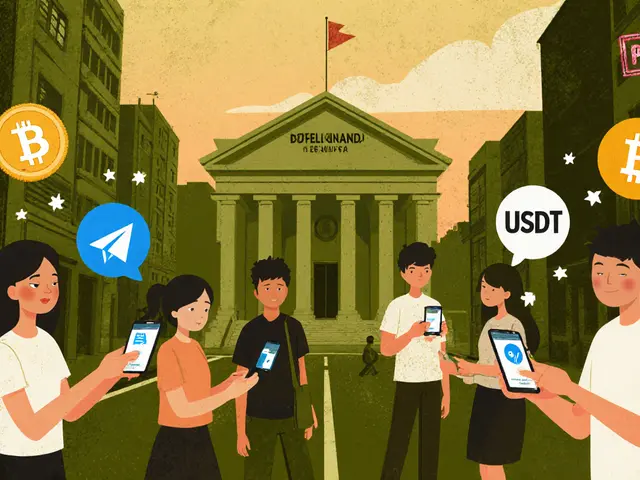
Imagine trying to buy a cup of coffee, but the store is illegal, the payment method is banned by your government, and if you get caught, you could lose everything. That is not a dystopian fiction for many investors in mainland China. Despite a comprehensive ban on cryptocurrency trading that has been in place since 2021, an estimated $86.4 billion in digital asset transactions flowed through underground channels between July 2022 and June 2023 alone. This figure dwarfs the legal market in nearby Hong Kong during the same period. So, how does this massive underground economy survive? And more importantly, what are the real dangers for those participating?
The Legal Paradox: Ownership vs. Trading
To understand the underground market, you first need to grasp the confusing legal landscape. In 2021, the People's Bank of China (PBOC) declared all commercial cryptocurrency services illegal. Banks were prohibited from facilitating any crypto-related transactions, domestic exchanges were shut down, and mining operations were forcibly dismantled. However, there is a critical nuance here: personal ownership of digital assets like Bitcoin or Ethereum is technically not illegal. You can hold them in your wallet.
This distinction creates a gray area that traders exploit. The problem arises when you try to convert fiat currency (Chinese yuan) into crypto or vice versa. Because banks are banned from processing these transfers, you cannot simply log into a bank app and buy Bitcoin. Instead, you must use unregulated peer-to-peer (P2P) networks or over-the-counter (OTC) brokers. While Chinese courts have referred to cryptocurrencies as "legal property" in some 2025 rulings, engaging in the act of trading itself remains a violation of financial regulations. This means that while your coins might be safe in theory, the method used to acquire or sell them exposes you to significant legal risk.
How the Underground Market Operates
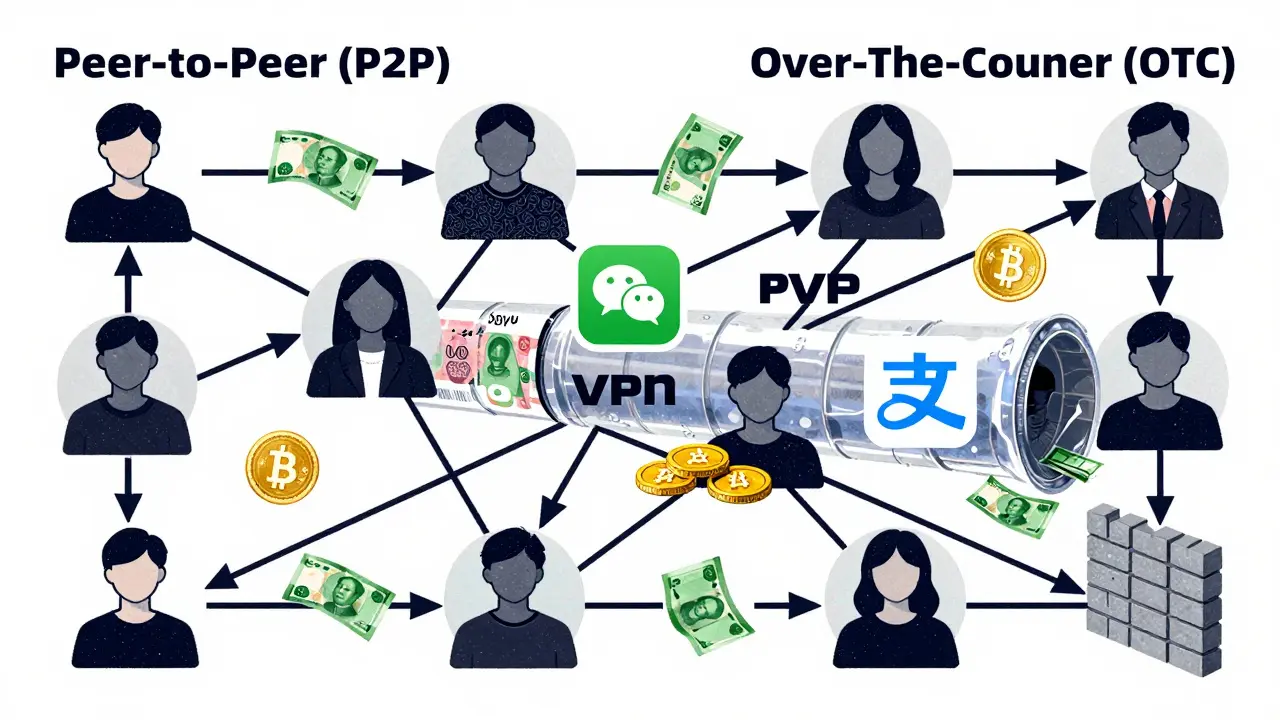
If you cannot use Binance, Coinbase, or any major exchange, how do trades happen? The answer lies in sophisticated shadow networks. The ecosystem relies heavily on three main pillars: Peer-to-Peer (P2P) platforms, Over-The-Counter (OTC) brokers, and Virtual Private Networks (VPNs).
- P2P Platforms: These are online marketplaces where individuals trade directly with each other. A buyer agrees to pay a seller via bank transfer or mobile payment apps like WeChat Pay or Alipay. Once the seller confirms receipt of funds, they release the cryptocurrency held in escrow. The risk here is entirely on the participants. If the seller disappears after receiving money, or if the buyer reverses the transaction, there is no customer support to help you.
- OTC Brokers: For larger sums, typically ranging from $10,000 to $1 million, traders use private OTC brokers. These are often high-net-worth individuals or small firms that facilitate large trades off-exchange. They offer better privacy and speed but charge higher fees. The proportion of these large retail transactions in China is nearly twice the global average, indicating that sophisticated investors dominate this space.
- VPNs and Proxy Servers: Since access to international crypto websites is blocked by the Great Firewall, traders rely on commercial VPN services and private proxy networks. Many users rotate between multiple VPN providers to avoid detection, adding a layer of technical complexity and cost to their trading routine.
Hong Kong plays a crucial role in this infrastructure. Many mainland traders establish banking relationships or corporate entities in Hong Kong, where crypto trading is legal and regulated. This allows them to move capital across the border legally, bypassing the restrictions imposed on mainland residents. It is a complex logistical dance that requires trust, connections, and significant time investment.
Why Do Traders Take the Risk?
You might wonder why anyone would risk legal penalties and operational headaches to trade crypto. The answer is simple: lack of alternatives. China’s traditional financial markets have offered poor returns in recent years. In 2023, the blue-chip CSI Index fell by 35% over 36 months, delivering the worst performance globally among major indices. Morgan Stanley analysts noted that earnings at listed Chinese companies missed forecasts for ten consecutive quarters.
Faced with a stagnant stock market and strict capital controls that prevent easy movement of wealth abroad, investors turn to cryptocurrency as a hedge against inflation and a way to diversify their portfolios. The underground market serves as a pressure valve for this pent-up demand. It is not just about speculation; for many, it is about preserving wealth in an environment where traditional assets are losing value. The scale of this activity-representing approximately 3% of China’s total annual GDP-shows that demand cannot be suppressed indefinitely by regulation alone.
| Feature | Mainland China (Underground) | Hong Kong (Legal) |
|---|---|---|
| Regulatory Status | Banned for commercial activity; personal ownership ambiguous | Licensed and regulated |
| Access Method | VPN, P2P, OTC brokers | Direct exchange access |
| Risk Level | High (Legal, Counterparty, Technical) | Low to Medium (Market risk only) |
| Consumer Protection | None | Available through SFC regulations |
| Transaction Volume (2022-2023) | $86.4 Billion | $64 Billion |
The Real Risks Involved
Participating in the underground crypto market is not just inconvenient; it is dangerous. The risks fall into three categories: legal, financial, and operational.
Legal Risks: Enforcement policies in China can change overnight. What is tolerated today might be prosecuted tomorrow. Participants face the threat of asset seizure, financial penalties, and even criminal prosecution if authorities determine that their activities constitute illegal business operations rather than personal investment. There is no clear legal recourse if your funds are frozen by a bank without warning.
Financial Risks: Without regulatory oversight, you have no protection against fraud. In P2P transactions, counterparties may default. Scams are rampant, from fake escrow services to phishing attacks targeting crypto wallets. Additionally, converting crypto back to yuan is difficult. Banks may freeze accounts associated with crypto transfers, leaving traders unable to access their own money. Stablecoins like USDT are often used as intermediaries to minimize volatility, but they still carry counterparty risk.
Operational Risks: The reliance on VPNs introduces technical vulnerabilities. If a VPN service is compromised or blocked, traders can lose access to their accounts or funds instantly. Furthermore, the psychological stress of operating in a legal gray area is significant. Traders report constant anxiety about being monitored, leading to a high burnout rate among active participants.
The Role of the Digital Yuan (e-CNY)
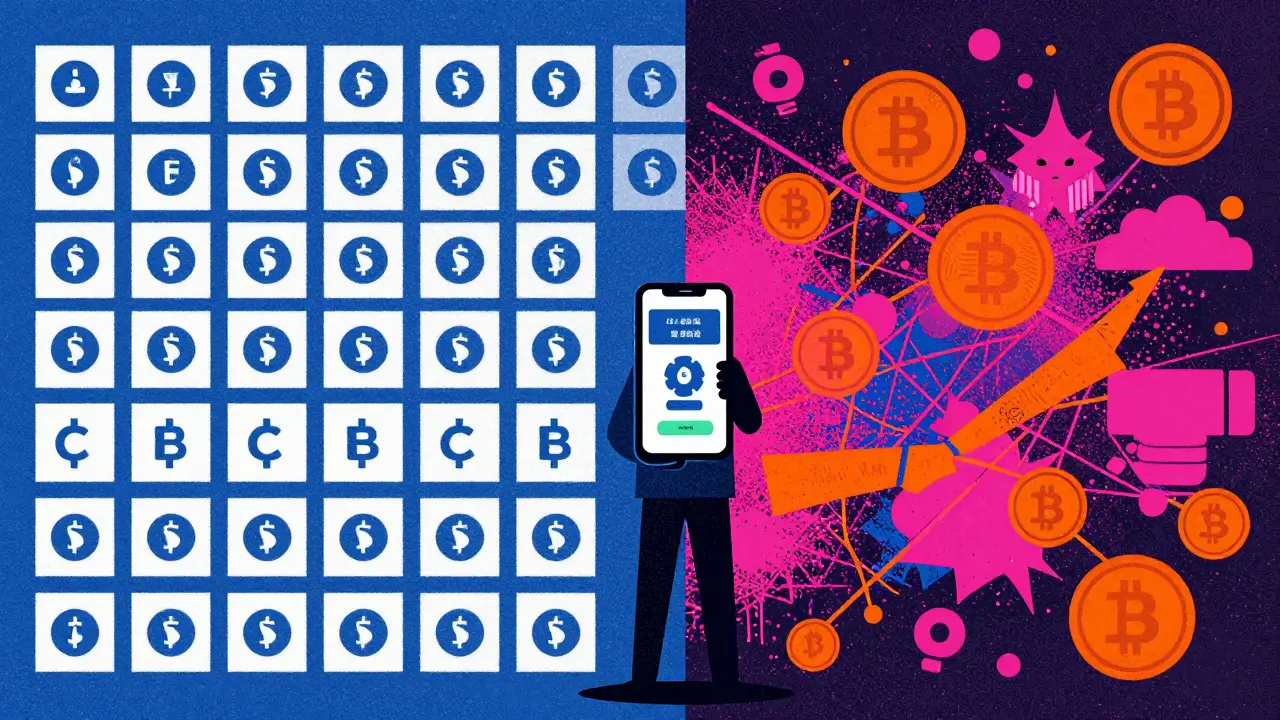
While cracking down on decentralized cryptocurrencies, China is aggressively promoting its own digital currency, the e-CNY. This state-backed digital yuan is designed to offer the convenience of digital payments while maintaining full government control over monetary policy. The e-CNY is not a substitute for Bitcoin; it is a tool for surveillance and capital control.
The government’s strategy is twofold: suppress decentralized assets that threaten financial sovereignty while providing a modern digital payment system that reinforces the existing order. Recent discussions in Shanghai regarding stablecoin regulations suggest a potential shift toward controlled re-entry into the crypto space, but likely only for state-approved assets. This creates a dual-track system where legal digital finance thrives under strict oversight, while the underground crypto market persists in the shadows.
Future Outlook: Will the Crackdown Continue?
Despite the risks, the underground market shows no signs of disappearing. Chainalysis data confirms that Chinese traders remain one of the most active groups globally, driven by persistent dissatisfaction with domestic investment options. Experts suggest that the market will likely persist and potentially expand as global crypto adoption grows.
However, the nature of the market is evolving. We are seeing a move toward more sophisticated structures, such as using Hong Kong-based entities for institutional-grade trading. Retail investors continue to rely on P2P networks, but they are becoming more cautious due to increased enforcement. The contradiction between courts recognizing crypto as "legal property" and banning trading activities creates pressure for regulatory clarification. Whether this leads to stricter enforcement or a controlled liberalization remains uncertain. One thing is clear: as long as capital controls remain tight and domestic returns are low, the demand for underground crypto trading will endure.
Is it legal to own Bitcoin in China?
Technically, yes. Personal ownership of cryptocurrencies like Bitcoin is not explicitly illegal. However, buying, selling, or exchanging crypto for fiat currency is prohibited for commercial entities and heavily restricted for individuals. Engaging in trading activities can lead to legal consequences, including account freezes and fines.
How do people trade crypto in China if exchanges are banned?
Traders use Peer-to-Peer (P2P) platforms, Over-The-Counter (OTC) brokers, and Virtual Private Networks (VPNs) to access international markets. Many also utilize Hong Kong-based banking accounts to facilitate legal cross-border transactions, leveraging Hong Kong’s more open regulatory environment.
What are the biggest risks of underground crypto trading in China?
The primary risks include legal prosecution, asset seizure, and lack of consumer protection. Financially, traders face high risks of fraud, counterparty default in P2P deals, and difficulty converting crypto back to yuan due to bank restrictions. Operational risks involve VPN failures and platform unreliability.
Why is the underground crypto market so large in China?
The market is driven by limited domestic investment opportunities and poor performance of traditional assets like stocks and real estate. With strict capital controls preventing easy wealth preservation abroad, cryptocurrencies serve as an alternative store of value and a way to diversify portfolios despite the regulatory risks.
Will China legalize cryptocurrency trading in the future?
It is unlikely that China will fully legalize decentralized cryptocurrency trading in the near future due to concerns over capital flight and monetary sovereignty. However, there may be controlled re-entry for specific assets like stablecoins or through regulated frameworks similar to Hong Kong’s model, while the underground market continues to operate.