Zenrock Yield Calculator
Estimate your annual yield using Zenrock's decentralized Bitcoin custody protocol. Current yield rates: 3.2% to 4.7% annualized.
Your Estimated Yield
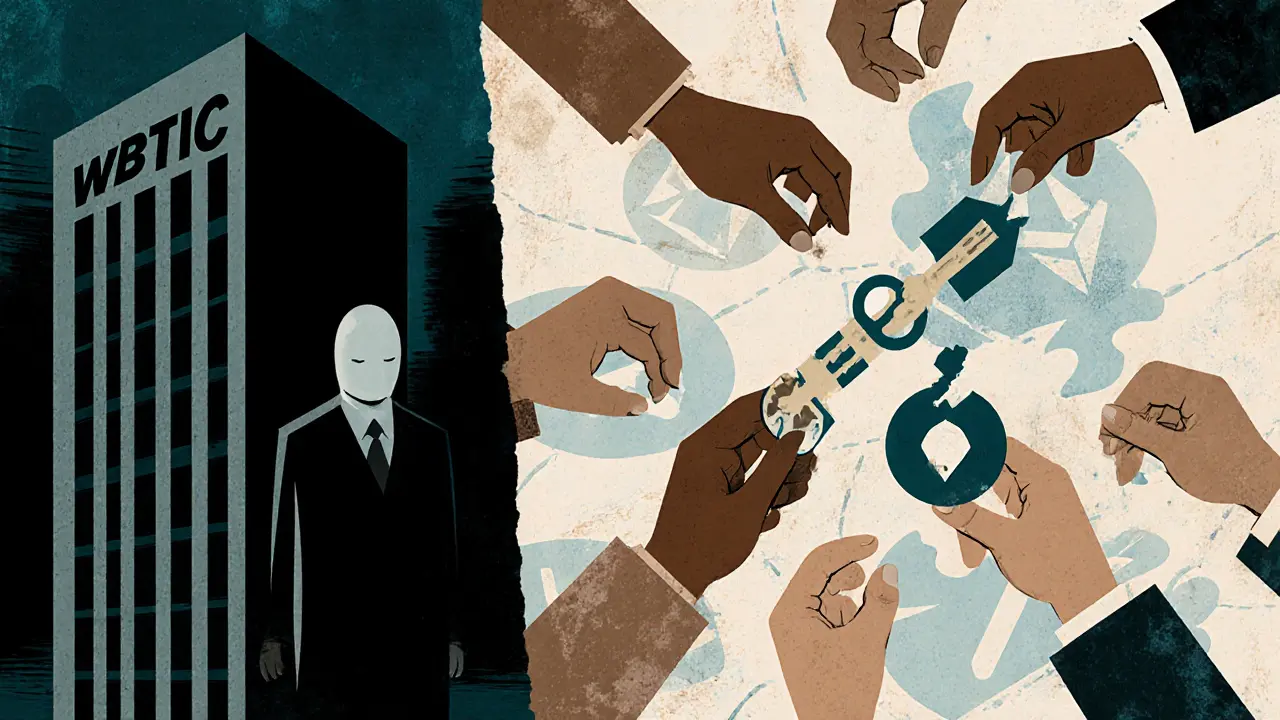
When you hear about wrapped Bitcoin tokens like WBTC, you’re probably thinking of a way to use Bitcoin on other blockchains. But most of them rely on centralized companies to hold the real Bitcoin behind the scenes. That’s where Zenrock comes in - it’s one of the few projects trying to do wrapped Bitcoin the right way: without trusting any single company or person.
What Exactly Is Zenrock?
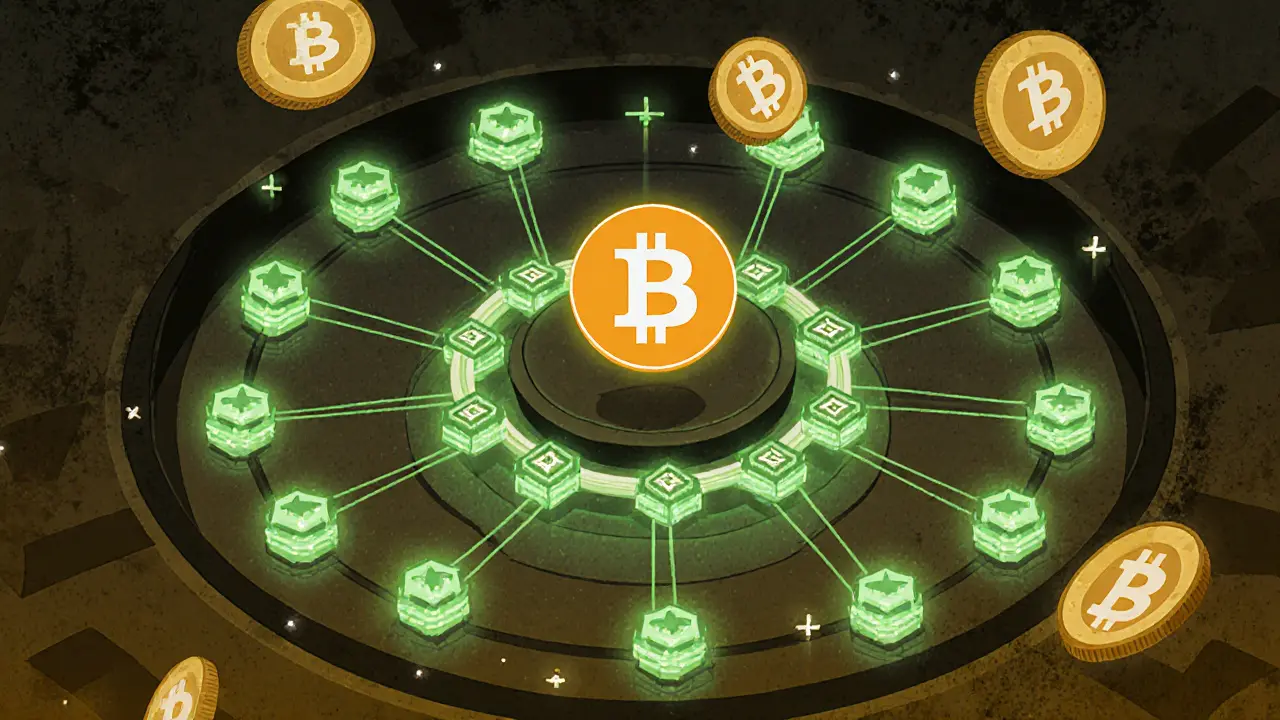
Zenrock is a blockchain project launched in 2023 that lets you turn real Bitcoin into a secure, yield-earning token called zenBTC - but without handing over control to a central exchange or custodian. Its native token, ROCK, powers the whole system. Think of it like a decentralized vault for Bitcoin that works across fast blockchains like Solana and SEI, letting you earn interest while keeping your Bitcoin safe.The core idea is simple: Bitcoin is the most trusted digital asset, but it’s slow and expensive to use in DeFi. Wrapped Bitcoin lets you use it on other chains, but most wrapped versions (like WBTC) are controlled by a small group of companies. Zenrock removes that risk by using something called distributed Multi-Party Computation (dMPC). Instead of one entity holding the keys, 51 different computer nodes share them. To move any Bitcoin, at least 34 of those nodes must agree. That’s not just secure - it’s designed to be impossible for any single hacker or insider to steal.
How Does ROCK, the Token, Work?
ROCK is the fuel of the Zenrock system. It’s an ERC-20 token on Ethereum, but it’s bridged to Solana and SEI to interact with zenBTC. There are exactly 1 billion ROCK tokens ever going to exist - no inflation, no more printing. As of mid-2024, about 220 million were in circulation, with the rest locked up for future development, team incentives, and ecosystem growth.Every time someone interacts with the Zenrock protocol - like minting zenBTC or moving funds - 0.25% of the ROCK used gets burned. That means the total supply slowly shrinks over time. As of June 2024, over 41,000 ROCK had already been burned. That’s a small deflationary mechanism, but it’s meant to create long-term scarcity.
ROCK also gives holders voting rights. If you hold ROCK, you can vote on upgrades, fee changes, or new chain integrations. This makes it a true governance token, not just a speculative asset. But here’s the catch: right now, very few people actually vote. Most of the supply is held by the team or locked in staking pools, so real decentralization is still a work in progress.
What Is zenBTC, and Why Does It Matter?
zenBTC is Zenrock’s flagship product. It’s a 1:1 wrapped version of Bitcoin, but with one big difference: it earns yield. While most wrapped Bitcoin just sits there, zenBTC is connected to EigenLayer, a restaking protocol that lets users earn 3.2% to 4.7% annual interest on their wrapped Bitcoin - all without selling it or leaving the Ethereum ecosystem.This is huge for DeFi users. If you own Bitcoin and want to use it in lending, borrowing, or liquidity pools on Solana, you normally have to give up security for speed. Zenrock says you don’t have to. You get Bitcoin’s security, Solana’s speed, and Ethereum-style yield - all in one package.
As of July 2024, the total value locked (TVL) in zenBTC was just $1.82 million. That’s tiny compared to WBTC’s $11.3 billion. But the growth rate is notable: wallet addresses holding zenBTC increased 17.3% month-over-month in early 2024. The real question isn’t whether the tech works - it does. It’s whether enough people will use it to make the network secure and liquid enough to matter.
How Is Zenrock Different From WBTC, tBTC, or SoBTC?
Let’s break it down:- WBTC is the biggest wrapped Bitcoin, but it’s fully centralized. A handful of companies hold the real Bitcoin. If one of them gets hacked or shuts down, your wrapped Bitcoin could vanish.
- tBTC (Threshold Network) is decentralized like Zenrock, but it uses a 100-node threshold. That’s more secure, but slower and more expensive. Zenrock’s 34-of-51 model is faster and cheaper.
- SoBTC is native to Solana and fast, but it doesn’t earn yield. Zenrock’s integration with EigenLayer gives it a clear advantage for yield seekers.
Zenrock isn’t trying to beat WBTC on volume. It’s trying to beat it on trust. If you care more about security than liquidity, Zenrock is one of the few options that actually delivers.
Is Zenrock Secure? What Do Audits Say?
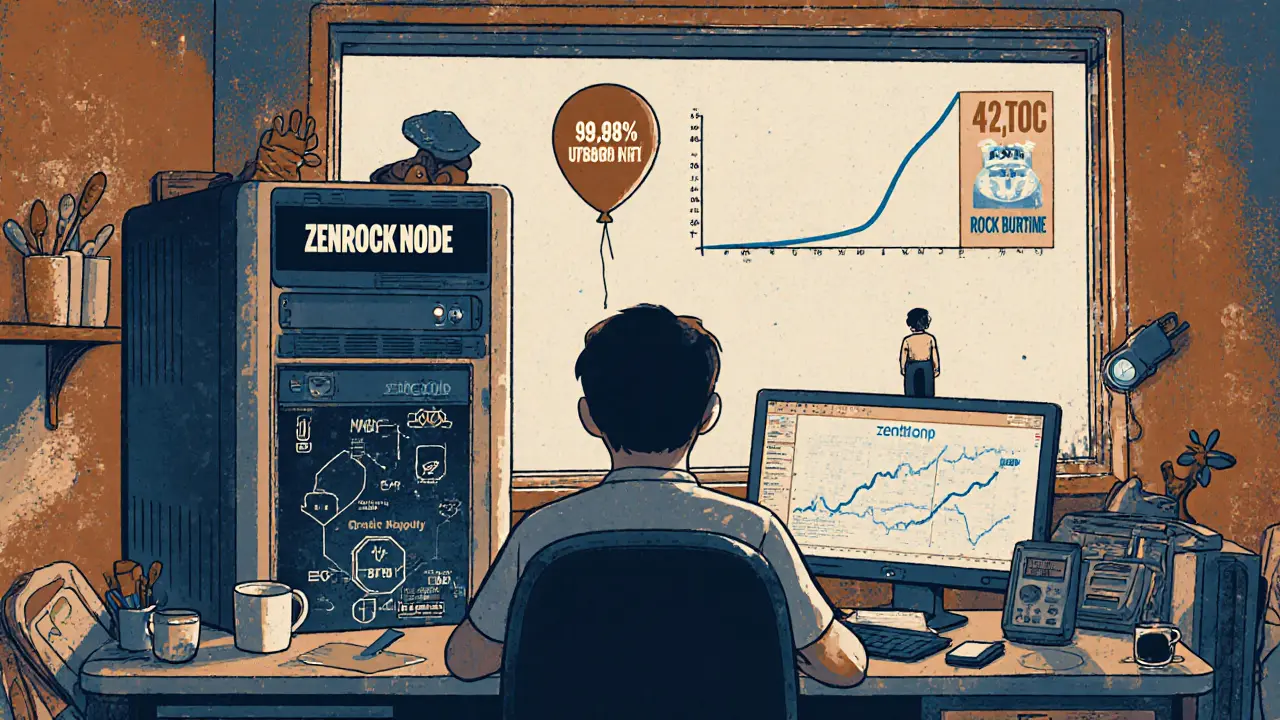
Security is Zenrock’s biggest selling point. The project was audited by two top firms: Trail of Bits and OpenZeppelin. Both gave clean reports after fixing three medium-severity issues - mostly around governance settings, not the core custody code. That’s a good sign. The dMPC protocol has been tested in simulations with 10,000 transactions, achieving 99.98% uptime and under 8-second processing times.But audits don’t prove decentralization. The real test is whether enough independent operators run nodes. Zenrock requires nodes to have 8GB RAM, 200GB SSD, and a 10Mbps connection - nothing crazy. But as of mid-2024, only a few hundred nodes were active. For full security, you need hundreds more. If node count drops, the system becomes vulnerable. That’s the biggest risk.
Can You Buy ROCK? Where Is It Traded?
Yes, you can buy ROCK - but it’s not easy. As of July 2024, it was only listed on one major exchange: Gate.io. The 24-hour trading volume was around $14,500 - extremely low. That means if you want to buy or sell more than a few thousand dollars’ worth, you’ll likely face huge slippage or get stuck with an order that won’t fill.Price-wise, ROCK traded between $0.016 and $0.028 in mid-2024. With a market cap under $4 million and a fully diluted value of $27 million, it’s a micro-cap project. That means wild price swings are normal. If you’re buying ROCK, you’re not buying a stable asset - you’re betting on the future of decentralized custody.
Who Is Using Zenrock? Real User Experiences
Most users are DeFi-savvy individuals trying to earn yield on their Bitcoin. Reviews on Trustpilot give Zenrock a 3.8/5. Common praises: the bridge interface is simple, and the node dashboard shows real-time security data. That transparency is rare.But complaints are loud and clear:
- "Too little liquidity on Gate.io - I couldn’t sell my ROCK without losing 15% in slippage."
- "The node operator docs are incomplete. I spent 40 hours trying to set it up and still had issues."
- "My $50,000 conversion failed because not enough nodes were online. The team had to manually fix it."
That last one is telling. If the system can’t handle a $50,000 transaction without human intervention, it’s not ready for mainstream use. The team admits this - they’re still in early adoption mode.
What’s Next for Zenrock? Roadmap and Risks
The roadmap is ambitious:- August 2024: Launch on Ethereum L2s (Arbitrum, Optimism)
- September 2024: Full decentralized governance interface
- December 2024: Expand to 10 more EVM chains
There’s also a partnership with Jito on Solana to integrate liquid staking - meaning zenBTC could earn even more yield.
But risks are real:
- Low liquidity: Without more exchanges, ROCK can’t grow.
- Node adoption: If no one runs nodes, the system fails.
- Regulation: The SEC is cracking down on wrapped assets. Zenrock’s decentralized model might help, but it’s not a guarantee.
- Bitcoin upgrades: If Taproot or another upgrade makes Bitcoin itself more DeFi-friendly, demand for wrapped Bitcoin could drop.
Analysts are split. Some call Zenrock "technically brilliant but executionally risky." Others see it as a potential leader in the next wave of Bitcoin DeFi - if it can solve the chicken-and-egg problem of liquidity and security.
Should You Care About Zenrock?
If you’re a casual crypto user who just wants to hold Bitcoin and trade it on Coinbase - no, you don’t need Zenrock.But if you’re deep into DeFi, care about decentralization, and want to earn yield on your Bitcoin without trusting a company - then Zenrock is one of the most interesting experiments in crypto right now. It’s not perfect. It’s not liquid. It’s not easy. But it’s trying to solve a real problem that most other projects ignore.
Think of it like early Ethereum: slow, expensive, and full of bugs - but the idea was powerful enough to change everything. Zenrock might not be the winner. But if decentralized custody takes off, it could be one of the first to prove it’s possible.
How to Get Started With Zenrock
If you want to try it:- Get a Solana wallet like Phantom or Sollet.
- Go to zenrocklabs.io and connect your wallet.
- Complete KYC (it’s required).
- Bridge your Bitcoin to zenBTC (you’ll need to send BTC to their secure address).
- Once minted, use zenBTC in DeFi apps on Solana or SEI.
For node operators: the setup takes about 40 hours. You’ll need a dedicated server, technical knowledge, and patience. The reward? Voting power and potential future token incentives - but no guaranteed payouts yet.
Start small. Test with $100. See how it works. Don’t invest more than you’re willing to lose. This isn’t a get-rich-quick play. It’s a bet on the future of trustless Bitcoin.

Sharmishtha Sohoni
November 29, 2025 AT 12:55So zenBTC earns yield via EigenLayer? That’s actually clever. Most wrapped BTC just sits there like a statue. If this works at scale, it could be the first real bridge between Bitcoin’s security and DeFi’s utility.
Jess Bothun-Berg
December 1, 2025 AT 03:36Wow. Just... wow. Another crypto project that thinks ‘decentralized’ means ‘I’ll write a whitepaper and hope nobody checks the node count.’ 51 nodes? Only a few hundred active? And you’re calling this secure? LOL. The SEC is gonna eat this alive.
Steve Savage
December 1, 2025 AT 03:49I get why people are skeptical-but let’s not throw the baby out with the bathwater. Early Ethereum had way worse UX, zero liquidity, and people were calling it a scam too. Zenrock’s tech is legit. The problem isn’t the protocol-it’s the chicken-and-egg cycle. No one uses it because it’s small, and it’s small because no one uses it. If they can get 10k nodes online and list on Binance, this could be huge. Patience, people.
Althea Gwen
December 2, 2025 AT 00:22so like... if i hold rock, am i basically betting that people will care enough about decentralization to pay for it? 🤔 because right now it feels like buying a ticket to a concert that hasn't been announced yet 😅
Sarah Roberge
December 2, 2025 AT 19:40okay but the fact that a $50k transaction failed because nodes were offline is not a bug, it's a FEATURE of capitalism?? no wait that's not right... i think i'm having an existential crisis. also the docs are trash. i spent 3 days trying to set up a node and now i just cry into my oat milk latte. why does crypto always feel like trying to assemble ikea furniture with blindfolds??
Andrew Brady
December 3, 2025 AT 05:57This is a globalist crypto scheme disguised as decentralization. The U.S. dollar is still the most secure asset on Earth. Why are we letting some Indian and Silicon Valley tech bros run a private key system that could be hacked by a single rogue node? This isn’t innovation-it’s a Trojan horse for financial collapse. And don’t get me started on the fact that they’re using Ethereum and Solana-both controlled by foreign entities. Wake up, Americans.
They say it’s audited by Trail of Bits? So what? Those guys got paid to say nice things. Real security is a U.S. government-backed custody solution-not some blockchain magic trick with 51 computers. This is the new financial colonization.
And don’t tell me about ‘voting rights.’ Who’s voting? The same 3 people who created it? That’s not democracy. That’s a cult. And ROCK? More like R.O.C.K. = Risk Of Communist Kinetics.
Stay gold, stay sovereign, and keep your Bitcoin on a cold wallet where it belongs-under your mattress, preferably in a safe with a U.S. flag on it.
Durgesh Mehta
December 3, 2025 AT 14:15the node setup docs really are a mess but i managed to get one running after reading 12 forum posts and watching a 2 hour yt video in hindi with bad subtitles. its slow but it works. also the burn rate is kinda nice, feels like saving a little each time i use it. maybe if more people chip in we can actually make this thing work. no drama just do the work
Steve Savage
December 4, 2025 AT 01:45Hey @DurgeshMehta - I saw your node setup story. That’s the spirit. One node at a time. The real win isn’t the token price-it’s building the infrastructure. I’ve been running one for 6 months. Got my first vote in last week. Slow? Yes. Worth it? Absolutely. Keep going.